
The impact of artificial education on business education worries Freeman School Dean Paulo Goes, but after nearly four years of discussion, planning and pilot projects, he says Freeman is well positioned to prepare students for an AI-powered future.
Ernst & Young announced in August it was investing $100 million to reward employees who excel in the skills needed to get the most out of AI, including business acumen, judgement and adaptability.
PwC, meanwhile, just launched a talent development program built on combining the power of AI with human skills like critical thinking, empathy and creativity. KPMG redesigned its audit training program to focus not on technical skills but on human abilities such as agility, people skills and professional demeanor.
Artificial intelligence is quickly reshaping nearly every function of business, leaving companies struggling to align organizational goals with employee skills. But professional services firms aren’t the only ones grappling with how to prepare workers for this new reality. It also keeps business school deans up at night.
“I think a lot about business education,” says Freeman School Dean Paulo Goes. “If you think about what we do, we form knowledge workers. We form people who analyze information, process data, validate results and practice due
diligence. AI has the potential to eliminate a lot of that because that’s also what AI does, so our focus as a business school is going to have to change.”
As a scholar of business information systems, Goes recognized the transformative power of AI early on. In October 2022 — two months before the first public release of ChatGPT — Goes released a strategic plan for the Freeman School that explicitly acknowledged the disruptive force of artificial intelligence and called for enhanced experiential learning to convey the skills needed to apply it — those same skills that professional services firms are now struggling to teach employees.

Over the last four years, Dean Paulo Goes has made artificial intelligence education a focus of the Freeman School’s strategy.
“AI will never be able to read a room,” Goes says. “That’s where humans come in — leveraging their own experience and intuition to adapt and lead. It’s not about replacing or substituting work. It’s about complementarity — how you
can work together with AI and be more than the sum of your parts.”
As Ernst & Young, PwC and KPMG can attest, cracking that code is a work in progress. The good news is that in the four years since the release of that prescient strategic plan, the Freeman School has made dramatic strides in AI
education, with new platforms, new courses, new curricula and new appointments designed to make the use of AI a fully integrated component of the Freeman experience.
The first step was introducing faculty and students to the technology.
In 2024, the Freeman School partnered with Colorado-based EdTech startup BoodleBox to launch a collaborative AI workspace for faculty and students. BoodleBox provides users with access to more than 30 leading AI models —including ChatGPT, Claude, Gemini, Perplexity, Llama, and specialized coding and image models — in a single interface. But beyond LLM access, the platform also offers a host of features designed specifically for education, including
prompt engineering, support for lesson planning, syllabus creation and teaching workflows, secure knowledge and file integration, the ability to create custom bots with specialized instructions, and, importantly, the ability to manage collaboration though group chats and shared folders. With BoodleBox, faculty members can assign AI-based projects to students and then review how they interact with the models to help them improve their skills and ensure they’re using the technology responsibly.
With the launch of BoodleBox, faculty integration of AI into the classroom shifted into high gear. This year, more than 100 faculty members are teaching AI-assisted projects in 130 different courses, from Financial Statement Analysis
and Business Statistics to Advanced Marketing Strategy and New Product Development. Last year, the Master of Business Analytics program was renamed the Master of Business Analytics and AI to reflect the expanding role the
technology now plays in the program’s curriculum. Among the new courses currently offered or planned in the coming year are AI for Business, Applied AI in Finance, Applied Machine Learning and AI, AI-Enabled Entrepreneurship,
AI in Marketing, Growth Strategy in the Age of AI, and Strategic Communication in the AI Era.
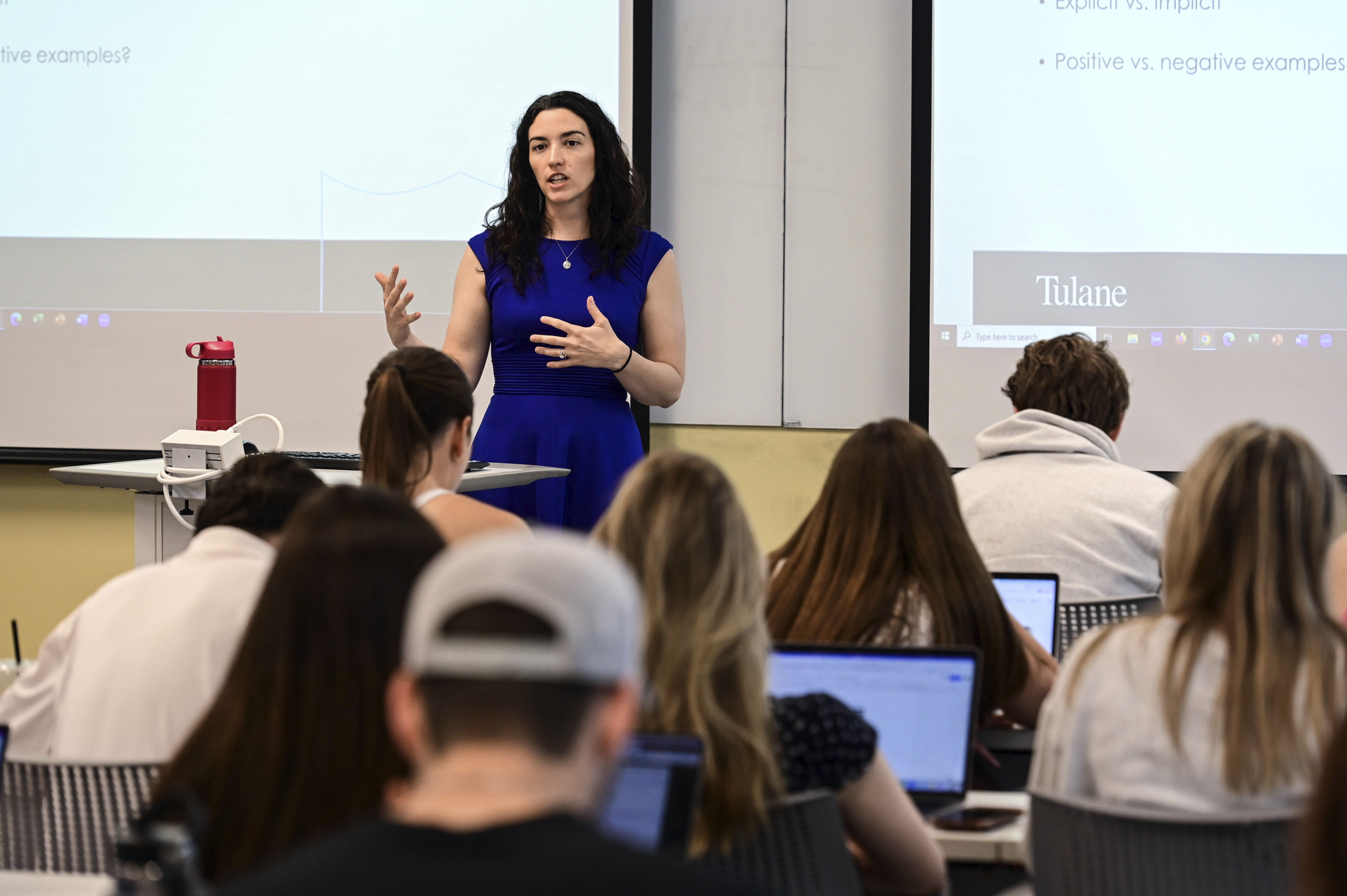
Assistant Professor of Management Natalie Longmire created AI-based simulations in her Leadership course to enable students to explore messy, high-pressure workplace situations that are difficult to recreate in traditional lectures or case studies.
We’ve always paid attention to soft skills at Freeman, but what we’re doing now is developing courses that tie together experiential activities with AI,” Goes says. “That’s where students are going to develop the really important
skills that employers are looking for.”
One of the first instructors to adopt this new approach was Rob Lalka, professor of practice in management and executive director of the Lepage Center for Entrepreneurship and Innovation. Lalka initially worried that AI might mean
the end of his Cases in Entrepreneurship course as students turned to ChatGPT for answers instead of grappling with the dilemmas presented in the cases. But instead of banning AI, Lalka leaned into it.
Last year, for a case examining the corporate governance crisis at Uber, Lalka created a custom AI chatbot modeled on company co-founder and former CEO Travis Kalanick. Lalka had students play the role of Uber directors confronting the embattled CEO during a company board meeting. As the Kalanick bot pivoted and pushed back on accusations, the students were forced to think on their feet and respond in real time.
More recently, Lalka created a pair of chatbots for a case on Palantir, whose contracts with Immigration and Customs Enforcement (ICE) provoked divisions within the company between rank-and-file employees and CEO Alex Karp. For
an in-class simulation, Lalka had students play the roles of both employee and executive in discussions, arguing the employees’ position to a bot modeled on Karp and then taking on the role of CEO to defend the company’s position
to a bot voicing employee grievances.
“What I found was the opposite of what I initially feared about AI,” Lalka says. “Students don’t want to take the easy way out and rely on a summary, because being unprepared becomes obvious very quickly once the simulation starts. The students who have carefully read the case, wrestled with the details, and thought about the competing arguments have much more to work with when the conversation takes an unexpected turn. So rather than replacing the case method, AI has given us a way to make preparation matter more. It’s enlivened the discussions, raised the stakes of participation and made the learning experience much closer to the ambiguity of actually making decisions inside an entrepreneurial organization.”
Natalie Longmire, assistant professor of management, uses AI in her Leadership class to run simulations she built to teach ethical decision making and leading diversity.
“Both simulations are designed to give students practice with the kinds of messy, high-pressure workplace situations that are hard to recreate through a lecture or traditional case discussion,” she explains. “Simulated colleagues, supervisors and customers might push back, escalate the situation or introduce new complications. Each student receives a unique and path-dependent experience, and then we come together to discuss common themes and challenges they faced. Using AI in this way allows me to create a safe but realistic environment where students can learn to recognize ethical situations, experience the consequences of different choices, and build confidence navigating difficult conversations and decisions before they encounter them in the workplace.”
Assistant Professor of Accounting Jake Krupa uses AI to enhance his Accounting Analytics course. Students previously spent the first half of the semester learning the basics of Python and then applied that knowledge to a massive
Chicago taxi dataset with the goal of surfacing insights that a ride-hailing competitor would find useful. With AI, students now let BoodleBox write the code, enabling them to take on the higher-value role of reviewing the output for
errors, revising the approach and evaluating how the ultimate findings would inform decision makers.
“What I’m teaching is business judgment,” Krupa says. “What questions are worth asking, what a visualization should communicate, and how the analysis’ output is relevant to the decision at hand. The AI executes the technical work,
and the students drive the judgment calls. That’s a managerial skill firms now expect graduates to have on day one, and it’s what I’ve built AI integration in the course around.”
Michael Wilson, senior professor of practice in management, integrates AI throughout his Management of Technology and Innovation course. Students initially use AI as a virtual partner in the Capsim Global simulation, relying on it to analyze performance, identify strengths and weaknesses, predict competitors’ moves, and generate data-driven recommendations. The course culminates with teams delivering a live presentation to an AI board member in which the students summarize their performance, highlight their strategic decisions and demonstrate how they integrated AI into the company’s decisions.
“I want students to learn that AI becomes valuable only when they treat it as a strategic partner — uploading real company data, running scenarios, and measuring its effect on profitability, market position and innovation speed,” Wilson says. “I also want them to improve their ability to design prompts, orchestrate multiple models and defend the resulting decisions so they can quantify ROI and present it with confidence to any stakeholder.”

Rob Lalka, Albert Lepage Professor in Business, reenergized his Cases in Entrepreneurship course by creating custom chatbots that enable students to question and engage with simulations of the individuals in the cases.
In addition to academic areas, AI is also integrated throughout Freeman career services. In the required freshman Career Development and Management course, AI is positioned not as an available tool but as a core professional
competency. Under the guidance of Career Management Center staff, students use AI for career exploration, industry and company research, resume and cover letter review, professional communication and outreach, interview prep
and coaching, networking and relationship-building, and personal brand development.
“What we’re building is the ability to pair AI with the human skills that set candidates apart: critical thinking, authentic communication and relationship-building,” says Tori Lane, director of Career Education and Strategy. “AI
can help make students more efficient and prepared, but those human connections create the real competitive advantage, especially with our incredible alumni network.”
While faculty and staff are working on immediate applications of AI, Dean Goes is looking ahead, planning for a future that’s still very unclear.
Last spring, BoodleBox founder and CEO France Hoang visited the Freeman School to meet with faculty and students. Hoang argued that AI isn’t replacing knowledge work. It’s just shifting the labor.
Traditionally, workflows have followed a bell-shaped curve, with minimal effort at the beginning “define” phase, intensive work in the middle “design” and “create” phases, and minimal effort at the end on the “validate” phase. AI inverts
that curve, Hoang argued, collapsing the effort needed to design and create and shifting human value to the beginning and end phases. In an AI-powered future, people will spend more time at the beginning ensuring they’re asking the
right questions and more time at the end reviewing and validating the results.
“In business education, we tend to teach students how to do the middle part of the curve,” Goes says. “That’s what we’re good at. With AI, we have to change the way we think about teaching. For the end of the curve, the validate phase, I think we can do a good job because we teach so many consulting projects. Our students have the judgement they need to check the output, evaluate their results and make recommendations. For the front of the curve, however, you typically need experience in order to ask the right questions, so we’re going to have to figure that out.”
Cameron Verhaal is one of the people charged with figuring it out. In July, Goes appointed Verhaal, an associate professor of management, to serve as Freeman’s inaugural Faculty Director of AI Initiatives. In that role, he oversees the development and implementation of AI activities across the school with the goal of positioning Freeman as a leader in the new space. Verhaal had previously served as chair of
Freeman’s Faculty Working Group on AI, which was established in 2024 to monitor developments in AI and advise the dean on strategy and curriculum.
“When you utilize AI, it creates the content for you, but you have to spend a lot more time training the model and verifying the work that it created,” Verhaal says. “So it’s just shifting the way we do work. When we give students assignments, those assignments have to reflect that shift. We have to assess them based on their ability to ask the right questions and analyze the output to make sure it accomplished what it was supposed to accomplish.”
 This fall, Verhaal is teaching AI and the Future of Business, a new freshman course designed to prepare students for that shift.
“The goal is two-fold,” he says. “Number one is just to get to the students early on as freshmen and create a baseline level of competence about what AI is and how to use it. The second goal is to stop students from thinking of AI as
a substitute that does the work for them and to start them thinking about AI as a complement, almost like a teammate they can use to iteratively improvement their assignments.”
If this semester’s offering is successful, Verhaal says the goal is to make it a required freshman course that would, like Career Development and Management and Management Communication, provide students with an essential skillset applicable across all business areas and functions.
Four years after highlighting AI education as a critical strategic goal, Goes says the Freeman School is in a good position.
“From talking to other deans, I think we’re actually ahead of the curve,” Goes says. “We started early with introducing AI to students and giving them fluency. That comes through exposing students, and it comes through repetition.
Many schools didn’t know what to do and came up with these big strategies, but at the time they didn’t know what AI was capable of.”
While we still don’t fully know what AI is capable of, we have a better idea than we did. Providing faculty and students with access to AI and appointing Verhaal to coordinate its implementation were crucial first steps, but Goes envisions much more, including the creation of a new center of excellence to drive AI education in the same way that the Schwartz Center leads experiential learning initiatives.
“With new technologies, you can never rest and say, ‘Okay, we’ll be here forever,’” Goes says. “You have to keep working hard and constantly evaluate what’s possible, because things are changing faster than anything we’ve ever seen before.”
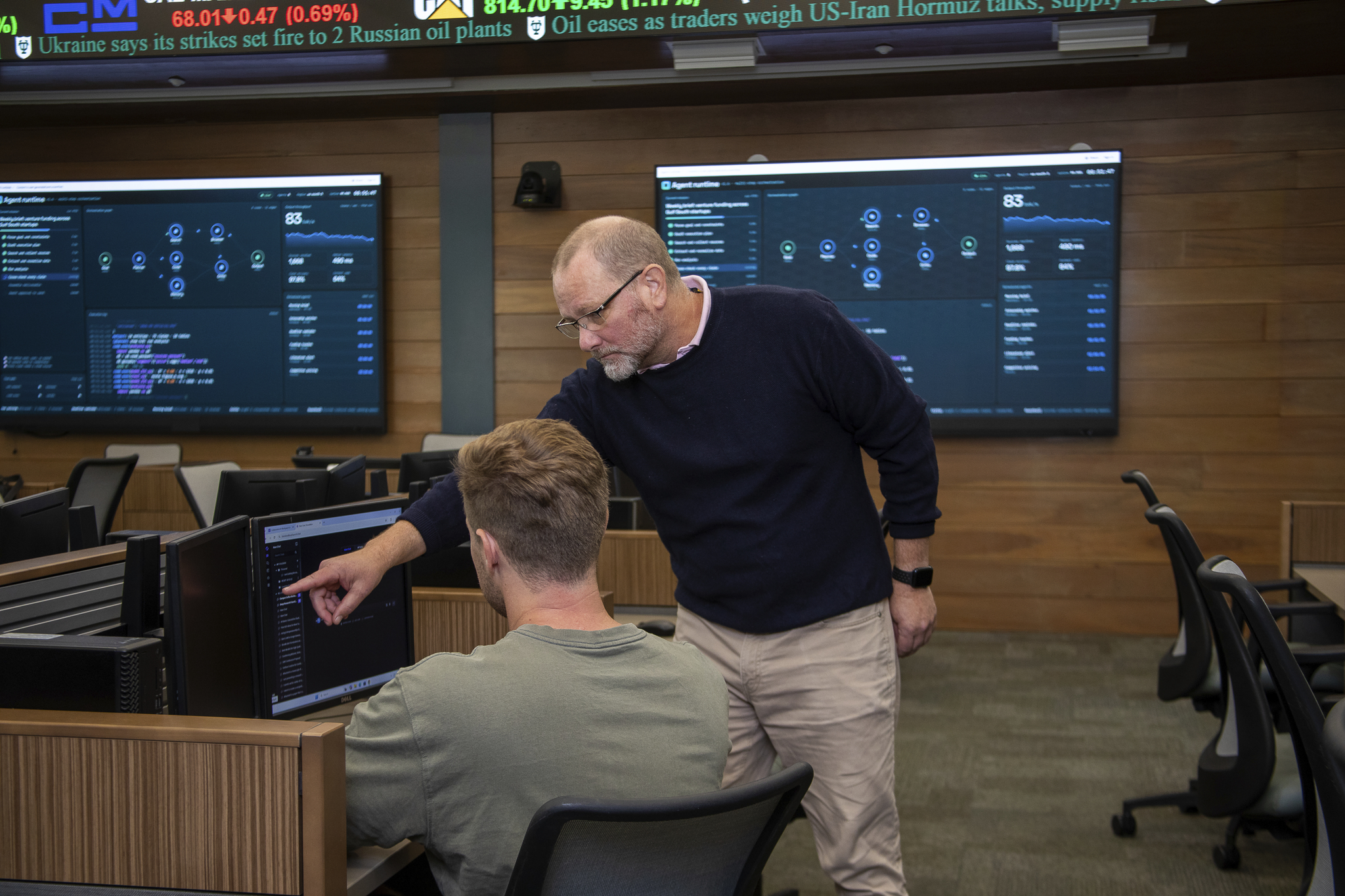
As faculty director of AI initiatives, Cameron Verhaal leads efforts to integrate AI throughout the school. This fall, he’s teaching AI and the Future of Business, a new freshman course designed to introduce students to business applications of the technology.