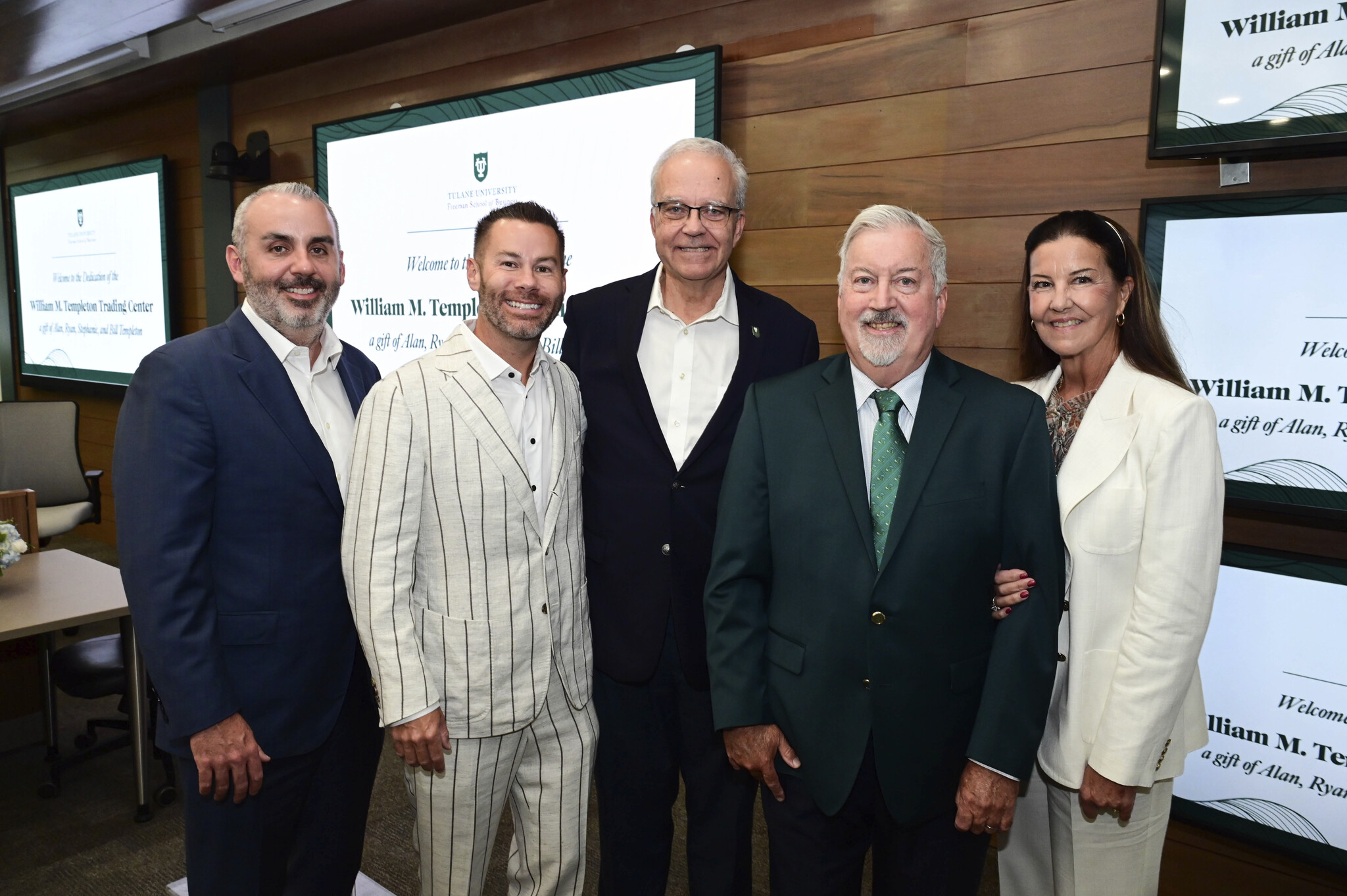
Bill Templeton, second from right, was honored in September at the dedication of the William M. Templeton Trading Center. Also pictured, from left to right, are Alan Templeton, Ryan Templeton, Dean Paulo Goes, and Stephanie Templeton.
In September, I was honored to welcome Bill Templeton (BA/MBA ’73) back to campus for the official dedication of the William M. Templeton Trading Center.
Last year, Bill and his family generously donated $1.5 million to the Tulane Energy Institute to advance energy education at the Freeman School. One of the first projects realized through that gift was the renovation of our trading room, which has provided students with immersive, real-world experience in portfolio modeling, commodity trading and energy analytics for nearly 25 years.
With the Templeton family’s support, the Trading Center was upgraded with high-resolution video walls, a real-time ticker display, an enhanced touchscreen instructor console, modern student workstations and state-of-the-art AV-over-IP technology. The facility has never looked better or featured more advanced technology, so it was a privilege to dedicate the space in honor of Bill and his family.
It is especially fitting that Bill’s name now anchors the Trading Center. As the founder of DCOR, Bill built the company into the largest operator of offshore oil and gas platforms in California, and under the leadership of Bill and his son, Alan Templeton (BSM ’02), DCOR has become an invaluable partner to the Freeman School. The company actively recruits our graduates, sponsors field projects for our Master of Management in Energy (MME) students, and recently
partnered with us to launch the Freeman Energy Leadership Program, a custom executive training initiative for their rising managers.
In his remarks at the dedication ceremony, Bill praised the MME program, pointing specifically to its emphasis on experiential learning. Through the MME, students gain the functional equivalent of on-the-job training while they’re still in school, graduating with the industry knowledge needed to deliver value on day one. Our students don’t need to complete lengthy onboarding or training programs before they start contributing, an advantage that saves employers tremendous costs in time and money.
Hands-on learning is nothing new for the Freeman School. We pioneered this approach with Burkenroad Reports, which puts students to work as equity research analysts, and the Darwin Fenner Student Managed Fund, which entrusts students with managing equity portfolios valued at more than $5 million. With the opening of the Schwartz Family Center for Experiential Business Learning last year, we expanded this model across the school, connecting undergraduate and graduate students with high-impact, real-world learning opportunities across every discipline.
Beyond energy, finance, marketing, analytics, management and entrepreneurship, there’s a new domain for which experiential learning has become indispensable: artificial intelligence.
Over the past year, the capabilities of AI have accelerated at a staggering pace, and organizations are moving swiftly to integrate the technology into their core operations. The momentum behind this fundamental shift will only grow.
In periods of profound disruption — when the real world is moving faster than textbooks can keep up with — experiential learning takes on even greater importance. To understand how AI drives business value, students need to apply AI to real-world challenges. That requires mastering both the technical competencies — things like prompt engineering and output validation — and the essential human capabilities needed to leverage the technology: communication, problem-solving, collaboration and critical thinking.
The cover story of this issue of Freeman Business explores how the Freeman School is preparing students for an AI-powered future. We took the first step in 2024 when we partnered with BoodleBox, a collaborative AI platform that provides access to leading AI models within a single, secure environment. Through BoodleBox, faculty can design AI-assisted learning projects and monitor student-model interactions to provide real-time coaching and reinforce responsible use.
We also introduced a new first-year course, AI and the Future of Business, to establish baseline AI literacy and set clear ethical standards for academic work. As students build this foundation, they can advance to specialized offerings such as AI-Enabled Entrepreneurship, AI in Marketing, Growth Strategy in the Age of AI, and Applied AI in Finance. In the coming year, we plan to introduce additional discipline-specific AI courses while integrating AI applications into
capstone and consulting projects at both the undergraduate and master’s levels.
We still don’t know all the ways in which AI will transform business over the next several years, but Freeman’s history of delivering relevant, high-value experiential learning gives us the agility, expertise and vision to ensure that our graduates will lead the way.