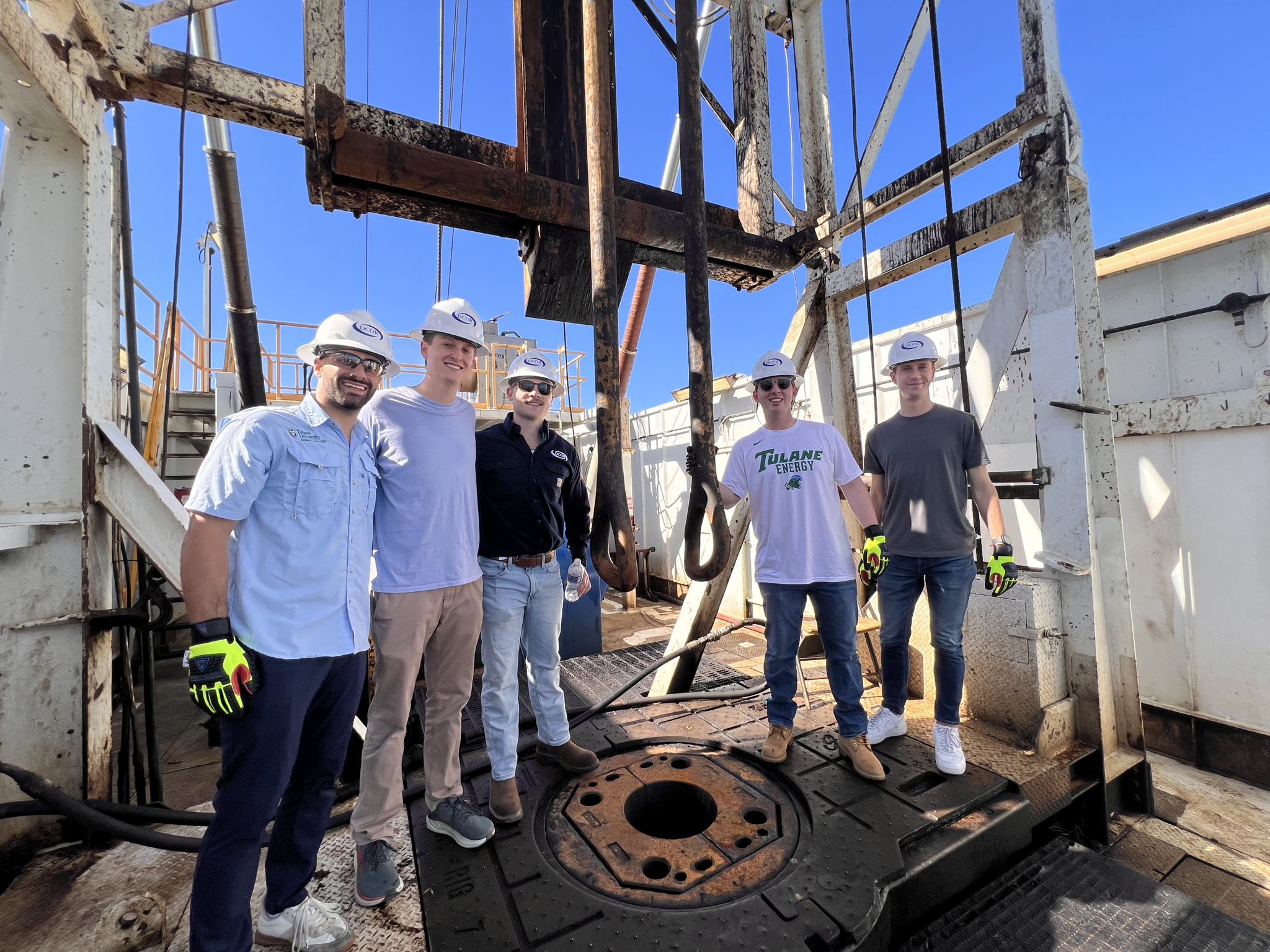
Manni Lulavy, Jack Lieux, Joseph Chase, Mike Berkowitz and Illia Kunin, left to right, on the floor of DCOR’s drilling rig on its offshore Platform A.
When DCOR CEO Alan Templeton (BSM ’02) agreed to work with a team of Freeman School Master of Management in Energy students, he expected to get a few useful insights out of the partnership. What he got instead were actionable recommendations with the potential to significantly reduce the company’s environmental impact while saving thousands of dollars in the process.
The recommendations were part of Energy Industry Projects, a course in the MME program that puts students to work on real, high-value projects for major energy companies. Four MME students spent the spring 2026 semester working with Oxnard, California-based DCOR, the leading offshore oil and gas producer on the West Coast.
“When Tulane reached out to DCOR to participate, we saw it as an opportunity to create a project that would be meaningful to the students as a learning experience but also meaningful to us as a business,” said Templeton.
The project ended up comprising three distinct areas of focus. One part looked at the feasibility of utilizing offsets to achieve carbon neutrality for the company’s operations in California. A second analyzed DCOR’s energy inputs and outputs to develop metrics the company could use in communications with regulators and stakeholders. The third assessed the financial feasibility of utilizing additional microturbines to generate electricity at three company facilities.
Joseph Chase (MME ’25), an operational FP&A analyst at DCOR, coordinated the project and served as the students’ point of contact at the company.
“When these deliverables were established, we wanted to make sure there was real value for us as a company and for the MME students,” said Chase, who joined DCOR last year after graduating from the MME program. “We gave the MME team a structure of how the projects needed to be built out and then provided them the access to use their skills to bring forward recommendations to consider.”
Mike Berkowitz (MME ’26), Ilia Kunin (MME ’26), Jack Lieux (MME ’26) and Manni Lulavy (BSM ’26) spent the semester immersed in the company’s operations, analyzing the impacts of California’s regulatory environment, building financial models and delving deep into the minutiae of Renewable Energy Certificate arbitrage.
Berkowitz, who focused on the microturbines study, said a highlight for him was traveling to California at the project’s midpoint to meet with company executives and visit the offshore facilities he was researching.
“When you actually go out on one of these platforms, you realize there’s so many more inputs to everything than you’d expect,” he said. “One of the things I like most about the MME program is that we do so many site visits. Being able to see things and get your hands dirty is so important for learning.”
The project culminated in May when the students presented their recommendations to company executives during an in-person meeting at the Freeman School. In addition to determining that the cost for DCOR to achieve carbon neutrality in California could be as low as $212,000, the students calculated that DCOR produces 45 times the amount of energy it uses, a powerful talking point in a state historically skeptical of fossil fuels. The students also found that expanding the use of microturbines to generate power on two offshore platforms and an onshore separation facility could reduce the company’s net electricity costs by more than 50% annually and generate net savings of $9.5 million over five years.
Templeton said he and his team were delighted with the recommendations.
“This was exactly why DCOR teamed up with the Freeman School,” Templeton said. “We were able to provide the MME students real-world experience, and they applied their skills to help us identify and bring forward solutions.
“I’m excited about our next project utilizing MME students,” he added. “I’m confident we’ll have several targeted areas that we will want to study, especially as we continue to expand into the Gulf. I’m looking forward to building an even
closer relationship with Tulane into the future.”
Berkowitz joined NextEra Energy’s rotational program in June, but he said he hopes to follow in Chase’s footsteps and become a project mentor next year.
“I’m already floating ideas to my boss about what we could do,” he said. “The DCOR project was easily the best educational experience I’ve had in my life, so I’m 100% going to try to do something like this for next year’s MME class.”