Today’s professionals face a startlingly different world than they did just a few years ago. The rise of artificial intelligence is upending old work processes and creating new ones, economic volatility has disrupted once-stable industries, and an increasingly global economy means enterprises feel geopolitical tensions more acutely than before.
To help professionals succeed in this rapidly changing environment, the Freeman School’s Stewart Center for Professional and Executive Education has transformed its approach to business education. In the two years since Dean Paulo Goes announced a restructuring to combine the Executive MBA program (EMBA), the Professional MBA program (PMBA) and the Online MBA program (OMBA) under one roof, the Stewart Center has modernized its curriculums to focus on job-ready skills, instituted flexible learning modalities, and created more opportunities for professionals across all three programs to learn from and network with one another.
“Our goal is to meet professionals where they are,” says Ashley Francis, who was appointed as assistant dean of the Stewart Center in 2024 and tapped to lead the center’s revitalization. “We want to deliver programs that help students advance in their careers and navigate these global transformations.”
“Students in our programs are working professionals who are really trying to take the knowledge and to apply it,” says Carmen Weigelt, associate professor of management and associate dean of the Stewart Center. “They are trying to translate new skills to their industry, so we designed a functional curriculum with that objective in mind.”
The results, Francis adds, have been impressive
“The ROI on a Freeman MBA is outstanding,” she says. “Our graduates are getting adulations at work, they’re learning new skills and they’re getting promotions.”
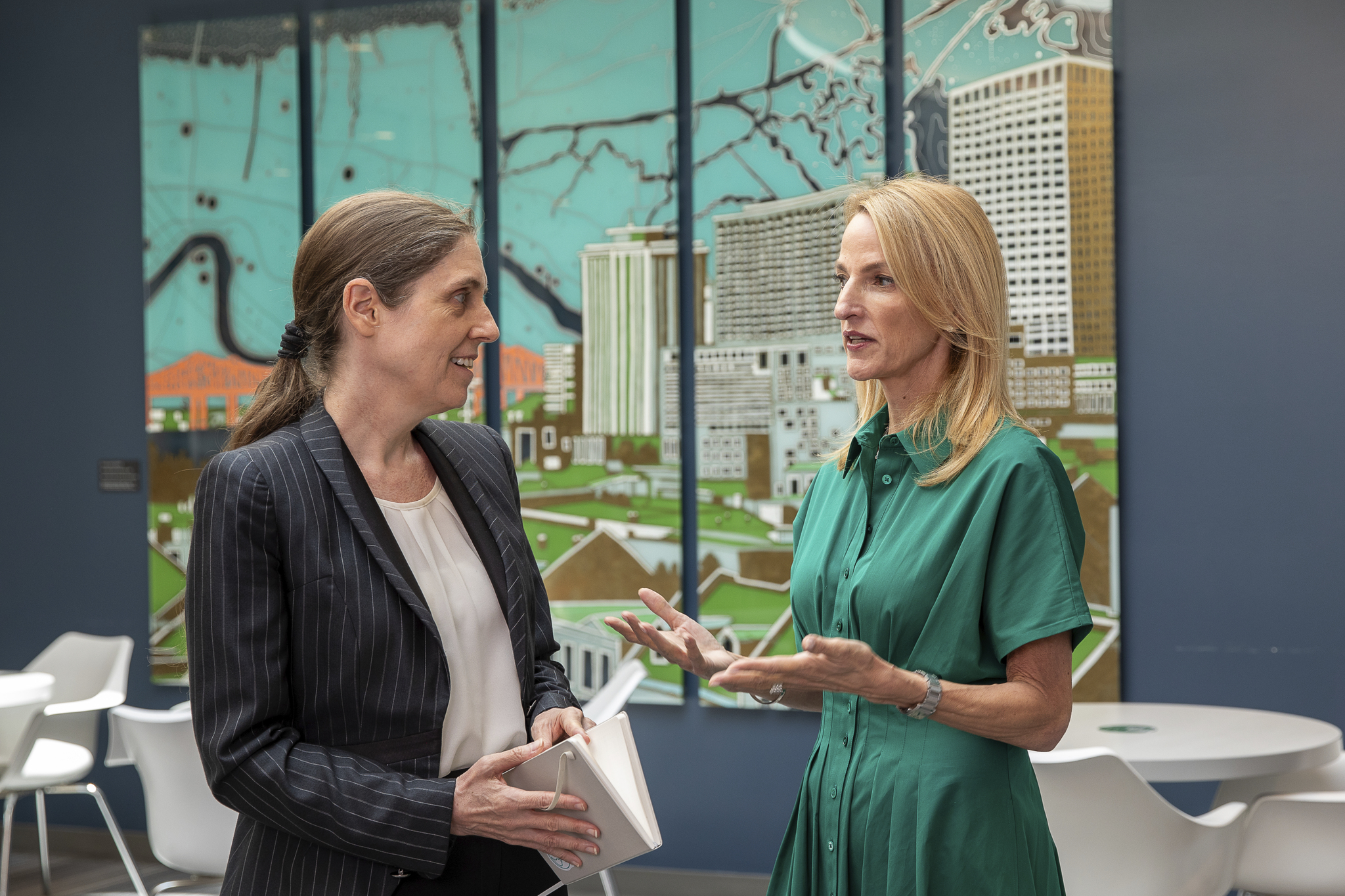
Associate Dean Carmen Weigelt, left, and Assistant Dean Ashley Francis lead the Stewart Center for Professional and Executive Education, which has transformed the Freeman School’s options for working professionals over the last two years with new programs, new features and new modalities.
THE EMBA PROGRAM: PREPARING LEADERS FOR TOMORROW
Since its launch in 1982, the Executive MBA program has supported the educational needs of thousands of business leaders as the Freeman School’s flagship offering for working professionals, but the needs of business leaders today are far removed from those of even just a decade ago. As part of the Stewart Center’s recent transformation, the EMBA was reimagined to meet the learning and scheduling needs of a new generation of business leaders. With an updated curriculum and hybrid format, the program enables students to gather on campus for monthly immersion weekends, then continue learning through live, synchronous online classes, a model that reduces travel demands while preserving a close-knit cohort experience.
For Chris Fulton (MBA ’25), a project manager at ExxonMobil, that flexibility proved invaluable.
“I’m on a plane all the time,” he says. “I was able to leverage the Zoom sessions, so when I was in Amsterdam or Singapore, I could attend classes online, and when I was in Baton Rouge, I could drive to New Orleans to attend the in-person classes. The hybrid model was a huge help when we welcomed our daughter in May 2024 and needed additional flexibility.”
The program also helps reduce the cost of travel through the EMBA Travel Stipend, which provides billing credits to offset expenses such as hotels, gas and meals associated with attending in-person classes.
To equip students with real-world knowledge, the updated EMBA curriculum emphasizes high-demand areas including artificial intelligence, strategic leadership, technology management and doing business globally.
Fulton, who is originally from Baton Rouge and was admitted to the program based on his extensive professional experience, says the redesigned curriculum aligned closely with the challenges he faces in his role at Exxon.
“The program blew me away,” he says. “It helped me understand my company’s big picture. I get why we’re doing mergers and acquisitions and why we’re doing enterprise scale strategy. My whole perspective has shifted since being
in the program.”
In May 2025 Fulton took advantage of one of the program’s signature courses, traveling to Cape Town, South Africa, as part of the Managing the Global Enterprise seminar.
“It was amazing,” he says. “We were doing a consulting project for a green energy company, so for me it was interesting to see another side of the energy industry. That’s what the EMBA program is all about — gaining a wider perspective.”
In addition to refining the quality and delivery of its executive education programs, the Stewart Center has continued to expand the value of the EMBA beyond the classroom through initiatives such as Leland Executive Coaching,
which offers students one-on-one executive coaching, and the Lifelong Learning Initiative, which allows graduates to return to campus for elective courses, enabling them to refresh their skills and stay connected with the Tulane community.
“We’ve responded to student feedback by creating a program that evolves with the business world,” Francis says. “As a result, we continuously receive positive feedback and high satisfaction rates from students.”
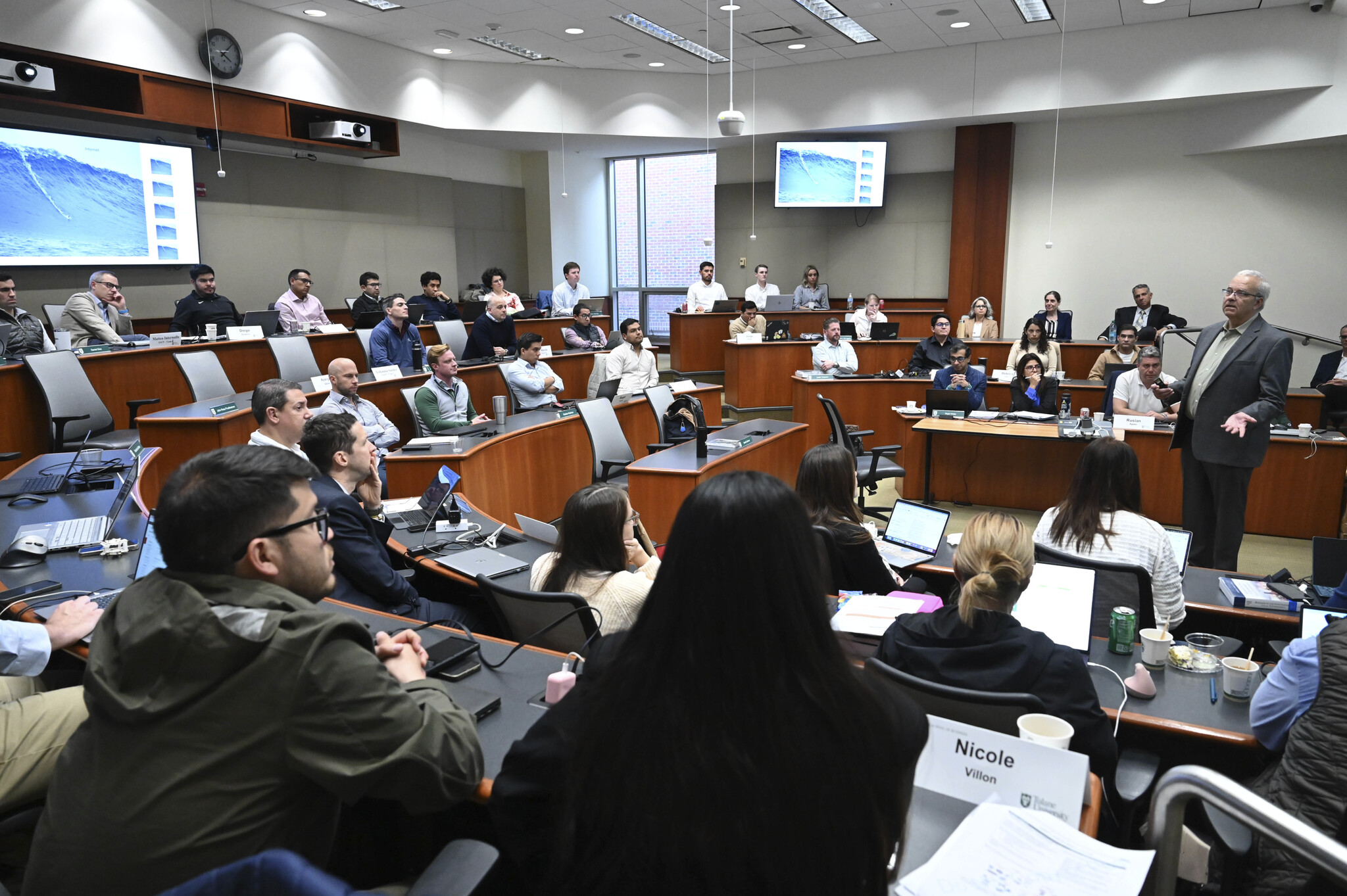
Freeman School Dean Paulo Goes, right, leads a class on AI in Business during EMBA International Week, which brings students in the Freeman School’s Executive MBA program together with peers from executive programs in Latin America and Europe.
THE OMBA: BUSINESS EDUCATION FROM AFAR
Expanding access to graduate business education was a central goal of the Stewart Center’s transformation. In 2023, the center launched the Online MBA to give working professionals the ability to earn a Freeman MBA from anywhere in the world. Since graduating its inaugural class in 2025, the program has become one of the Freeman School’s largest and fastest-growing MBA offerings.
To bring the OMBA program to life, the Stewart Center partnered with a nationally recognized instructional design team to build engaging, high-touch learning experiences. OMBA classes, which average around 25 students, meet
synchronously each week for discussions and group projects.
Raquel MacKenzie (MBA ’26) says the program’s remote learning option made graduate school possible for her. A civilian administrative professional at the Naval Air Station Joint Reserve Base in New Orleans and a single mother,
MacKenzie needed a program that could fit alongside her career and family responsibilities.
“Flexibility was one of the biggest factors in choosing an MBA program,” she says. “Freeman’s OMBA gave me the opportunity to pursue my education without putting my family or career on hold.”
The program has expanded its elective offerings to include courses on consumer behavior, corporate strategy and energy. Weigelt, who teaches in the program, says the courses maximize interaction rather than passive learning.
“Online learning has been a really positive experience, both for me and the students,” she says. “We have weekly roundtables and we make them very interactive. Rather than me lecturing, the roundtables are discussion based.”
For MacKenzie, this high-engagement approach made it easier to build relationships with other students in the program.
“Networking online felt very natural in today’s world,” she says. “Technology has changed the way we network, and the program reflected that. We collaborated regularly through discussions, group projects, and virtual communication, which helped build genuine connections.”
Whether online or in-person, these connections remain a defining feature of a Freeman education.
“The Freeman School is known for its extensive networking opportunities,” says Francis. “When students in the OMBA program come for graduation in May, they all know each other even though they’ve never been in the same city.
That’s because in addition to their classes, students in all the MBA programs have the opportunity to come together through social networking and virtual career management classes. They make the kind of connections that advance
careers, no matter where in the world they are.”

Online MBA student Stephanie Burchfield (MBA ’26), left, associate director of cultural resources with Edwards Pitman Environmental in Atlanta, meets with Monica Pazmino-Cevallos, assistant director of online learning, during a visit to campus.
A PMBA BUILT FOR WORKING PROFESSIONALS
One of the biggest barriers to entry for professionals considering an MBA is the time commitment. A three-year part-time program can stretch to five years or longer due to changes in a student’s professional or personal life, lowering the chances of the student completing the degree.
But through the Stewart Center’s new hybrid PMBA program, students can transition between in-person and remote coursework if they choose as their professional or personal circumstances change. By combining in-person evening classes with online learning, the program makes it easier to stay on track toward graduation.
For Julia Fawcett (MBA ’26), an accountant at Tulane University Libraries, the program’s convenient schedule made pursuing an MBA possible.
“I needed to be able to continue working while taking classes,” says Fawcett. “Freeman’s PMBA program had an evening schedule that fit really well with my work.”
Because she worked on Tulane’s campus, Fawcett chose to complete all of her classes in person. Still, she says the program’s structure helped her finish her degree in less than three years while attending part time.
“Even though I was in school just part time, I was able to earn my degree in under three years,” Fawcett says. “The three-hour intensive courses were a huge help in that, and I absolutely loved the format. The intensives took place over just two weekends, so I was able to earn credit for entire classes in half the time.”
The redesigned PMBA also gives students more ways to customize their experience. In addition to weekend intensives, eligible students can take electives alongside EMBA students and choose from new one-credit-hour Saturday
courses covering timely topics like AI-enabled entrepreneurship, managerial decision-making, data representation, international marketing and emerging markets.
Fawcett says those highly relevant courses were among the program’s biggest benefits.
“The classes were energizing,” she says. “I could bring those lessons into the office the next day. The Stewart Center totally changed how I operate, and I wouldn’t trade the experience for anything.”
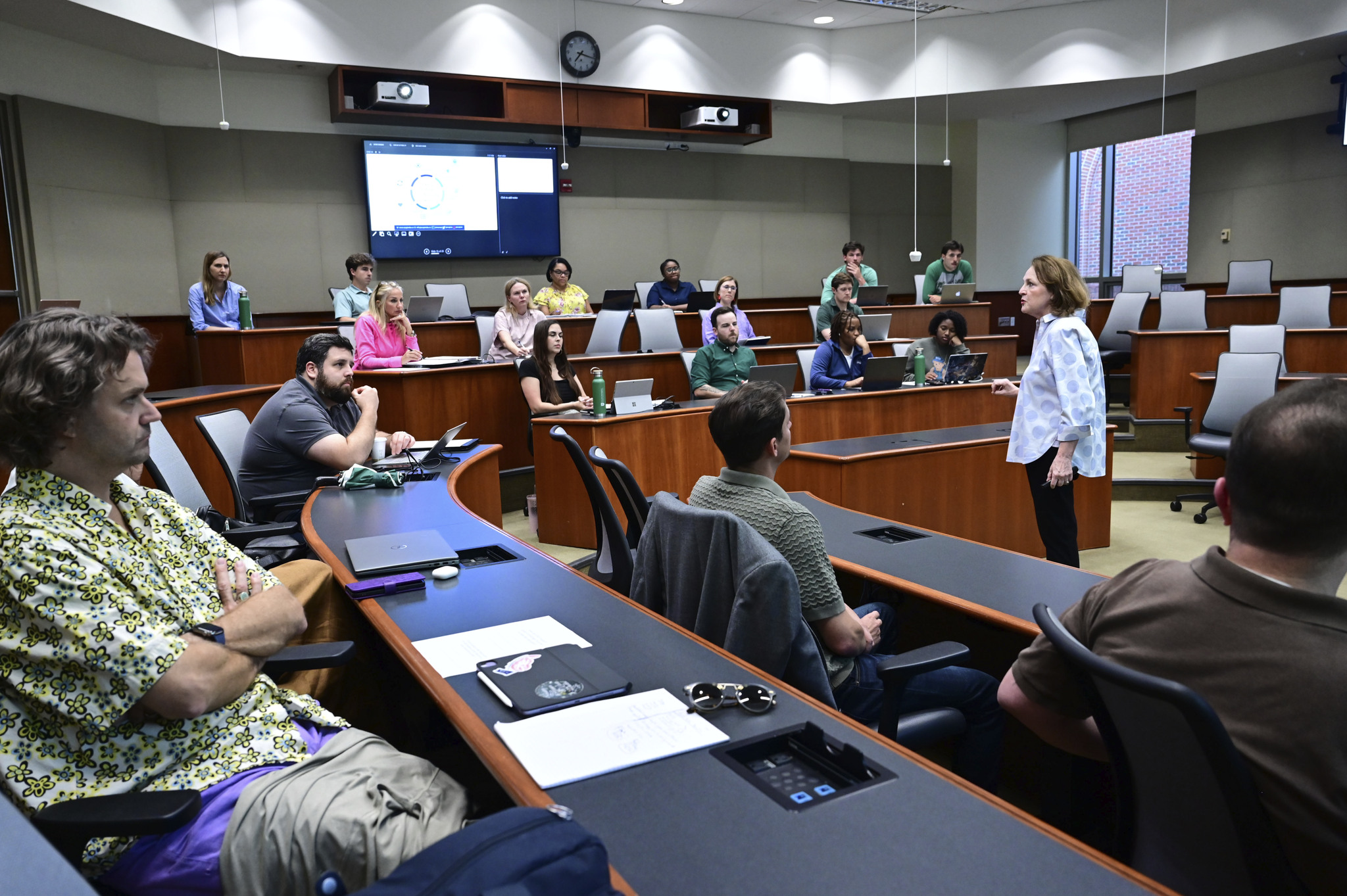
Senior Professor of Practice Ashley Nelson, right, leads an evening Management Communication class in the Professional MBA program.
BEYOND THE CLASSROOM: CERTIFICATE PROGRAMS
The Stewart Center’s transformation extends beyond its degree programs. Through customized executive education partnerships, the center is helping organizations invest in emerging leaders with tailored certificate programs.
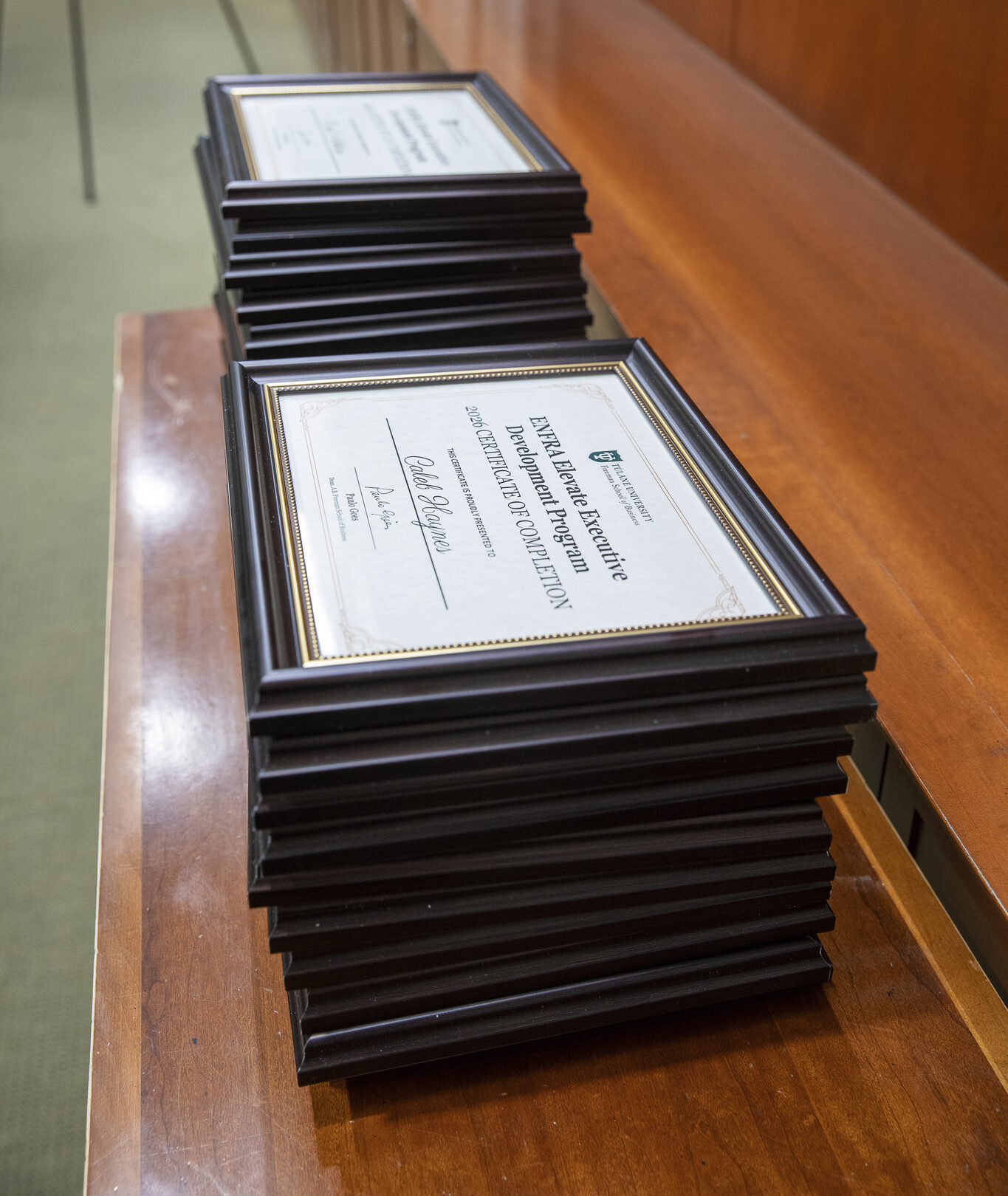
One of the center’s newest initiatives is the Elevate Executive Leadership Program, developed in partnership with ENFRA, a Metairie-based energy infrastructure company. Launched in 2025, the 12-month certificate program combines MBA-level coursework, executive masterclasses and collaborative peer learning to prepare current and rising leaders at ENFRA with the skills needed to drive the company’s future growth. The company celebrated the graduation of the program’s first cohort in September with a ceremony at the Freeman School.
For Jordan Tinsley, vice president of development at ENFRA and a member of the inaugural class, the program’s greatest value has been the opportunity to build relationships across the organization.
“It has been so rewarding to engage with my ENFRA colleagues in an academic context rather than a commercial one, since that setting gives us some freedom that we don’t necessarily have in commercial meetings,” Tinsley says. “Establishing and strengthening relationships with ENFRA colleagues I didn’t know well before the program has been wonderful, and I will value those relationships for years to come.”
Building on that momentum, the Stewart Center has also partnered with DCOR, California’s leading offshore oil and gas producer, to launch the Freeman Energy Leadership Program, a three-month executive development program designed specifically for the company’s key managers. Tailored to the energy industry, the program combines leadership strategy with the fundamentals of oil & gas finance to help participants better understand the rapid changes facing their company and industry.
“The program was extremely beneficial to me and our executive team to understand more fully the intricacies of oil and gas price forecasting and hedging and the numerous external influences that impact our day-to-day business and our bottom line,” says Bob Garcia, President of Blue Meridian Solutions, a division of DCOR.
Together, these partnerships reflect the Stewart Center’s broader mission to extend business learning beyond the classroom.
“Our customized executive education programs strengthen organizations as well as the career prospects of the people in them,” Francis says of the executive certificate programs. “It’s so gratifying to see people complete our programs and see immediate results in their careers.”

ENFRA managers Garrett Hensley, Austin Jackson, Eric Hartenstein and Landon Jones, left to right, talk during a break in the final class session of the Elevate Executive Leadership Program on Sept. 24. ENFRA partnered with the Stewart Center to create the program to give its rising leaders the skills. they need to drive future growth.