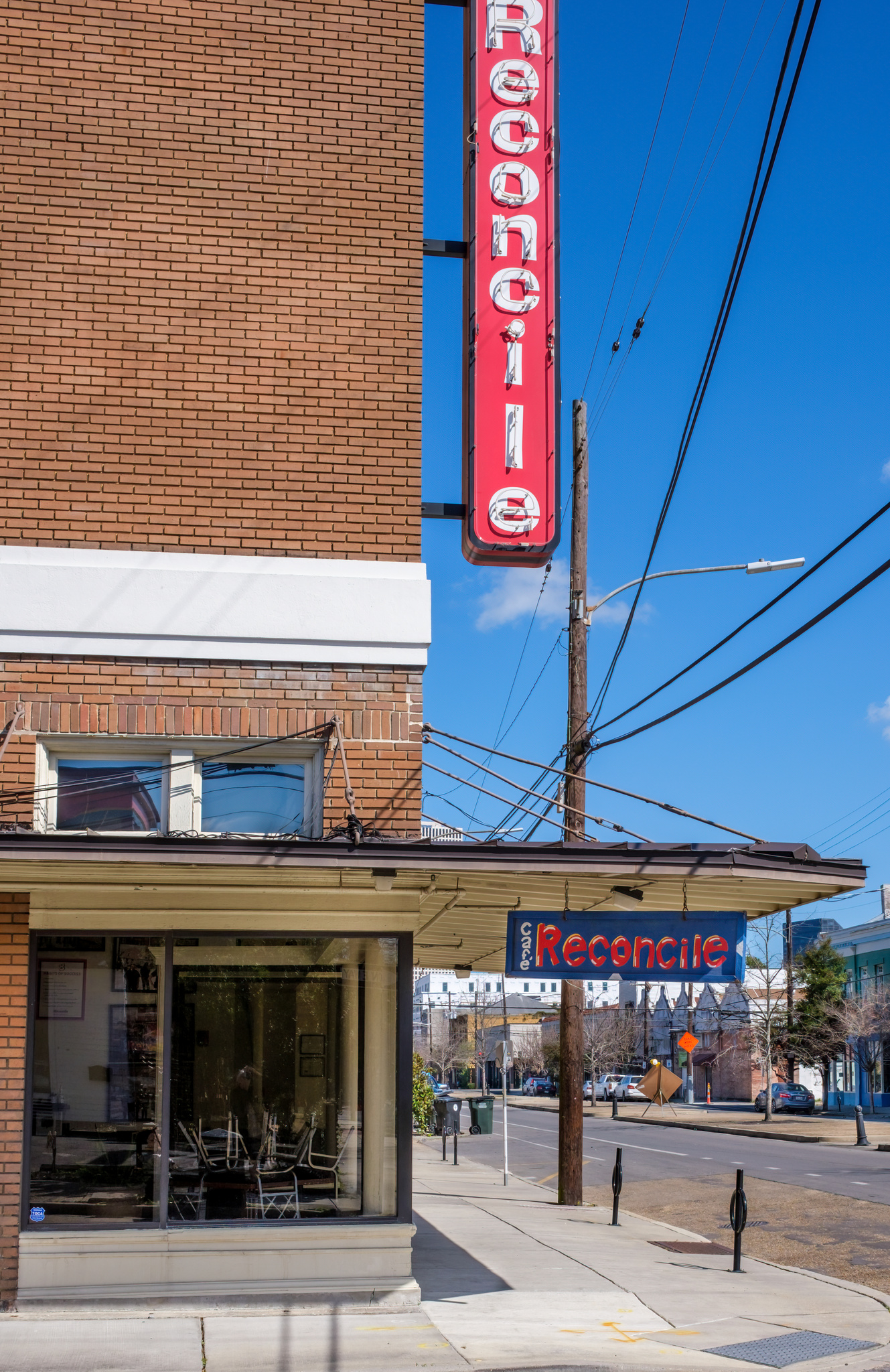
For their senior capstone project, a team of Freeman students partnered with Cafe Reconcile, a nonprofit restaurant in New Orleans that provides workforce training to at-risk youth.
New Orleans foodies know Café Reconcile for soul food staples like gumbo, red beans and rice, and fried chicken. The young people enrolled in its workforce readiness program, however, know the café for the opportunities it serves up.
Since 1996, Café Reconcile has trained over 2,000 low-income youth, giving them the experience and know-how they need for a career in hospitality. As a mission-driven enterprise, the café relies on revenue generated from its food sales and support from the local community to fund its operations.
The organization’s unique mission was on display when it partnered with the Freeman School to develop a plan for sustainably growing its catering operations. The project was part of the Freeman School’s senior capstone course, which puts students to work solving a real-world business problem for a local organization.
“When I heard I’d be working on this project, I thought it was such a cool concept,” said Ilanna Feldman (BSM ’26), a member of the capstone team. “Right away, we realized they are way more than a restaurant. They’re serving great
food while also running a very impactful social program, and they’re boosting the whole city in a lot of ways.”
The capstone team worked with Kheri Billy, CEO of Café Reconcile, and Dustin Farris, finance and administration manager, who provided background on the café’s unique business model and financial standing. Early on, the team recognized the café was facing major pain points in its catering program. Limited staffing combined with highly customized catering options were creating headaches for managers coordinating events.
“During our site visit, we got a comprehensive overview of all the different challenges that Café Reconcile is facing,” said Noa Arad (BSM ’26). “We started to understand that it’s not just about one small problem. It’s very complex
because in the restaurant industry, everything has to work together for smooth operations.”
Using financial data provided by Billy and Farris, the students analyzed the café’s recent performance, pinpointing areas for improvement.
“We found that between 2024 and 2025, their operating costs were higher, but their revenue was lower,” said Nefeli Ipsarides (BSM ’26). “To counter this, we thought it would be a good idea for the café to increase prices on its catering menu items by 10% and increase the prices of its regular menu items by 5%.”
The students also explored ways the café could better utilize its event spaces. As part of its catering services, Café Reconcile hosts gatherings in its historic five-story building in Central City, which includes indoor and outdoor event spaces.
“We toured the café’s second-floor catering space and outdoor space,” said Lindsay Armstrong (BSM ’26). “Finding out that they had an outdoor space was critical because we discovered they have additional space for hosting people. We encouraged them to really make use of those options.”

Another recommendation involved partnering with Tulane Service Learning to organize an annual fundraiser. Because Tulane undergraduates are required to complete service-learning coursework, the capstone team urged Café Reconcile to tap into this existing network of volunteers and supporters. The team argued that the fundraiser donations, combined with profits from the revised catering price structure, could be put toward hiring a new catering coordinator.
“This would really work to the café’s advantage,” Feldman said. “Tulane students would be doing all the planning and heavy lifting and ultimately the café could hire another team member.”
Billy said the Café Reconcile team appreciated the students’ creative approaches to revamping the catering program.
“We were impressed with the students’ recommendations,” she said. “The students demonstrated a strong effort to understand both the operational realities of our business and the broader mission of Reconcile New Orleans.
“Several of their recommendations aligned with areas we are actively evaluating as we work toward strengthening the long-term sustainability and growth of our catering business,” she added. “Their analysis provided valuable
insights and useful considerations for future planning.”
Professor of Practice Nicole Miller Regan, who oversaw the capstone course, said she was proud of the practical solutions the team was able to offer.
“The students helped the organization consider ways to transform its catering operations from a reactive, time-consuming model into a strategic, sustainable business that complements its training mission,” she said.
For the students, the capstone course provided an opportunity to contribute meaningfully to an organization making a difference in New Orleans.
“Here, we had a real impact,” said Kathryn Young (BSM ’26). “It was unlike other classes where we are just working to get a good grade.”
“It was a really special experience,” added Arad. “The café helps young people get work experience and it gives them a place where they feel like they belong. It was great to be a part of that larger project.”