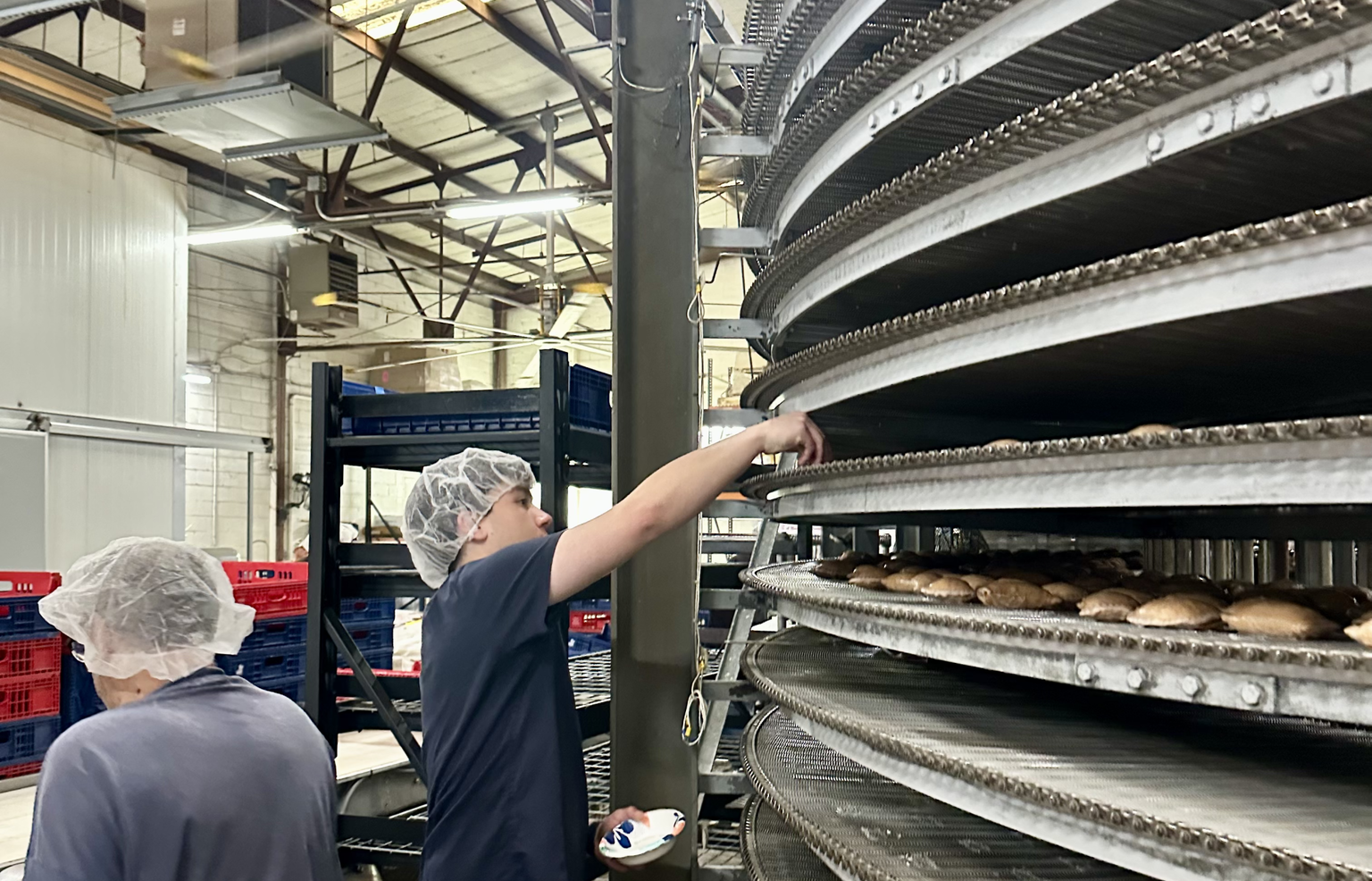
As part of their senior capstone project, Freeman students got an inside look at how Hubig’s pies are made, packaged and distributed. Here, a student samples a pie hot off the line.
Head to the checkout counter of a New Orleans grocery store and you’ll probably see them: Perched by the register and enveloped in crinkly wax paper emblazoned with the famous red and yellow Savory Simon logo, Hubig’s Pies have been a confectionary staple in New Orleans for more than a century.
The pies first hit shelves in the 1920s when Simon Hubig, son of German immigrant parents, founded a baking business in Fort Worth and expanded it to New Orleans. Over the years, the company weathered catastrophes including the Great Depression and Hurricane Katrina, but it was a 2012 fire that shuttered the business. Hubig’s finally reopened in 2022, and four years later, the company is still staging its comeback.
To help revive this New Orleans icon, a team of Freeman School students partnered with third-generation owners Drew and Kathleen Ramsey to develop a business plan for increasing Hubig’s profitability. The project was part of the students’ senior capstone, an experiential learning course that puts students to work addressing a real-world business challenge.
“This was not an academic exercise but instead a quest to help Hubig’s become more profitable and eventually expand territory,” said Professor of Practice Larry Merington, who oversaw the capstone. “Over the course of the semester, the students realized how special these little pies are in New Orleans.”
The challenge began with a consultation that introduced the students to the Ramseys, their company’s history and its products.
“From our consultation we learned that there’s a lot of nostalgia attached to the company,” said Hannah Meyer (BSM ’26). “They still mostly use the same ingredients and production processes as they did when they first opened.”
“What stood out to me from our initial meeting was how deeply Drew and Kathleen care about their brand,” said Isabella Rahi (BSM ’26). “The company has been passed down from generation to generation. The company is their baby, and that motivated us to handle this project with a lot of care and intention.”
The students also learned about the challenges the company has faced. Following the 2012 fire at its Dauphine Street headquarters, Hubig’s relocated to Jefferson and built a new facility. Today, however,
the company faces a new challenge: Growing its profitability.
 “Individual consumers can be price sensitive,” Rahi said. “So it’s difficult for the company to increase pricing, especially for what’s normally an impulse purchase in the checkout line. That was part of the problem we were trying to solve.”
To better understand the business, the students visited the company’s factory and viewed its production process firsthand. They learned that Hubig’s churns out more than 30,000 pies a day using a time-tested process: First, the dough is rolled into sheets and molded into the pies’ classic half-moon shape. Next, the pies are filled with apple, lemon or blueberry compote or pumpkin, coconut or chocolate filling. After a dip in the fryer, the pies make their way through
a curtain of icing, where they’re christened with Hubig’s glaze.
After seeing the factory in person, the capstone team set off to devise a growth plan, with Merington pressure testing their ideas along the way.
“In capstone, we press students,” Merington said of the learning process. “We make them work harder and go beyond obvious shallow thinking. In the end, they can proudly say that they’ve developed real, defensible and vetted courses of action for the company.”
“Throughout the semester, Professor Merington treated capstone like a business,” said Jane Manley (BSM ’26). “We were more like members of a company than students. That’s something I’ve never
experienced before.”
The semester culminated with a formal presentation at which the capstone team shared their findings with the Ramseys.
“Our recommendations were focused on streamlining Hubig’s operations and supporting sustainable growth,” said Rahi. “We thought focusing on those two things would be the best immediate course of action.”
The team recommended increasing wholesale prices to align with industry standards, amping up digital marketing efforts, expanding the company’s operational leadership team, and developing partnerships with local coffee shops and tourist organizations.
“The students recommended that we hire somebody so we can focus on other parts of the business, and that makes sense,” Drew Ramsey said. “They also had some good ideas about where we could expand. We’ve talked about the venues and the sports arenas, but we would very much like to get into the coffee shops as well.”
“I was impressed with the students’ depth of understanding,” added Kathleen Ramsey. “It can be really hard to understand some of the pain points without experiencing them firsthand, but the students were great, and I think the project really opened up their minds to the intricacies of running a small business.”
Following their presentation, the capstone team reflected on the experience.
“I’m from a small town, and I know how important small businesses are to the life of a place,” said Carmen de Juan-Roncero (BSM ’26). “It was a big responsibility and a big honor to help the Ramseys.”
“Hubig’s is a brand that’s just so deep-rooted in the community,” said Molly Johnson (BSM ’26), a native of Covington. “I was happy to help play a role in preserving it.”
“We’ve all made New Orleans our home for the past four years,” said Rahi. “I’m grateful that we had this opportunity to make an impact on the community.”